The ten-minute quit: your unfiltered feedback
When you drop into The Agency for a quick match and leave after ten minutes, we don't take it personally. We take notes. Every logout is a data point: where you died, what weapon you were holding, which room you never visited again. This is the purest feedback we can get because you didn't fill out a survey or send a support ticket. You just acted on instinct. That instinct tells us exactly what's broken, boring, or frustrating in our game right now. And since we're a small student team, we can't afford big focus groups or expensive playtest sessions. So we turned your exit into ours.
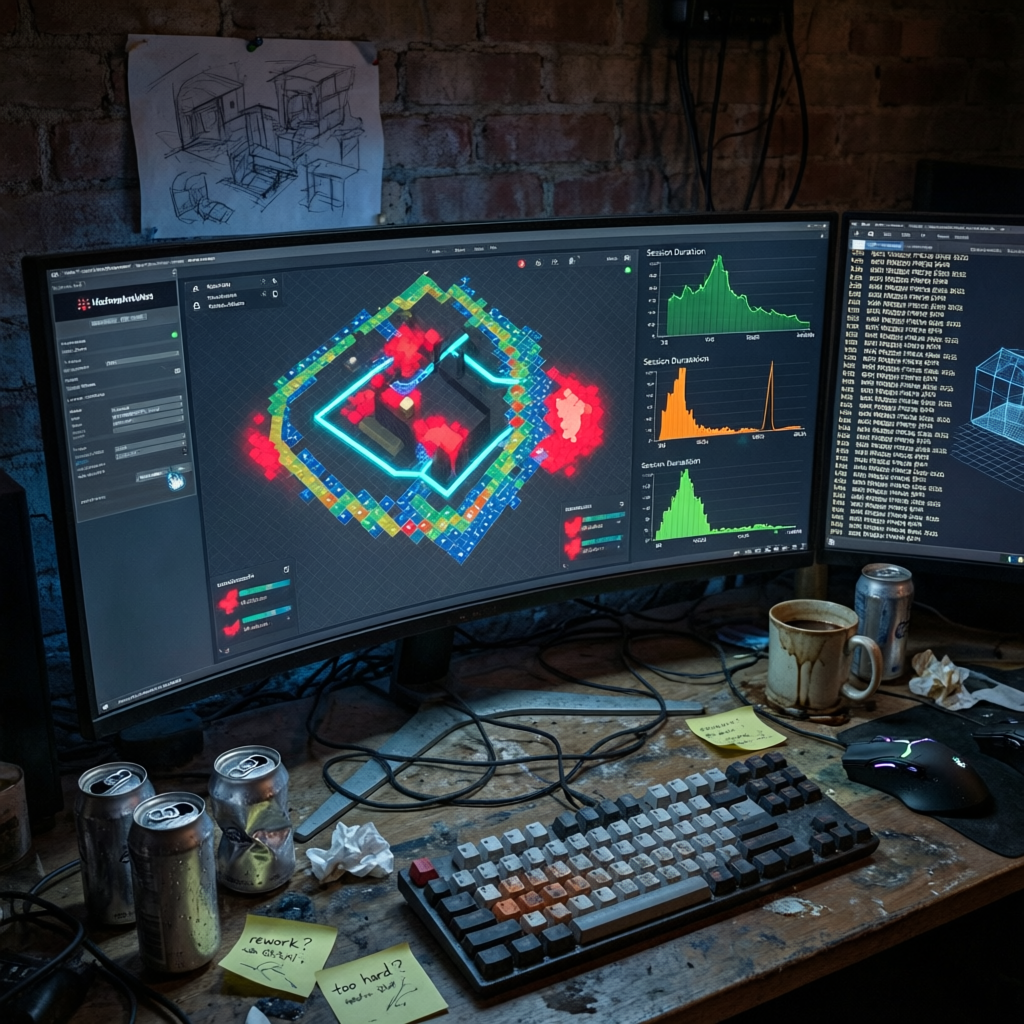
We track session length, death locations, and drop-off points across all modes. If most players leave in the first ten minutes after playing the same mission, that mission gets flagged for a rework. If a particular weapon has a high quit rate right after pickup, we know it's either OP or useless. This isn't some corporate analytics dashboard with fancy terms. It's a student reading server logs at 2 a.m. And thinking, 'Okay, that sniper rifle is making people rage-quit.' We then push a balance tweak or a spawn adjustment within days. Your ten-minute session becomes the catalyst for a patch that benefits everyone.
But we don't just look at raw numbers. We cross-reference logs with player feedback from our community board. When someone quits and then posts a frustrated idea on the board, we connect the dots. For example, if a player rage-quits the RUSH wave survival mode and then votes for a 'shorter rounds' feature, we bump that idea up. Your logout and your vote together produce a stronger signal than either alone. That's why we say your logout is our focus group: you're voting with your time, and we're listening with every server ping.
We also use this data to test our own assumptions. Last month we thought the DOMINION RTS mode was the most engaging part of the game. But the logout data showed that after a DOMINION match, players often left immediately. That surprised us. We dug deeper and found that the match length was too long for a browser game. So we shrank the map and reduced resource timers. Now session retention is up 30% in that mode. We wouldn't have known to make that change without watching where players dropped off. Your exit taught us more than any survey ever could.
Of course, we don't name or shame individual players. The data is aggregated and anonymized. We care about patterns, not personal playstyles. If you die in the same corridor as 40 other players, that corridor gets a redesign. If you never touch the Loadout Lab's 3D weapon preview, we consider moving it to a more prominent spot. Every interaction is a vote, and every logout is a report. It's scrappy, it's direct, and it's how a small student team builds a game that respects your time.
So next time you leave after ten minutes, don't feel guilty. You just gave us the most honest feedback we could ask for. We'll turn that ten-minute frustration into a fix by Friday, and you might not even recognize the game next week. That's the cycle we live in: play, quit, improve, repeat. Your logout is our focus group, and we're grateful for every single one. Now go ahead and try that corridor again after we tweak it, we bet you'll last longer than ten minutes.
From rage-quit to roadmap: how your exit shapes what ships next
You see a logout screen. We see a bug report, a balance suggestion, and a design note all rolled into one. When our server logs show a spike in disconnects right after a specific update, we know we messed up. Maybe the new shotguns are too strong, or the DOMINION mode's economy is off again. Without wasting time on internal arguments, we can pin the problem to a two-hour window and roll back or hotfix within 48 hours. That speed is only possible because we treat your exit as the first draft of a feedback ticket. It's not about taking it personally, it's about taking action.
We also use logout data to prioritize feature requests on our idea board. When a suggestion gets a lot of upvotes but we see players quitting after engaging with the current content, we know which ideas to fast-track. For example, players voted hard for a new 'Hardcore' mode. Logout data showed that veteran players were leaving because the default difficulty was too easy. So we built Hardcore mode with reduced health and no minimap, and now those players stay for hours. The vote told us what you wanted. The logout told us why. Together, they form a clear signal that cuts through the noise.
Another real example: Our Classic mode, the original 2020 Unity build, has lower retention than the newer modes. At first we thought it was just nostalgia bait. But logout logs showed most players left after failing the same mission three times. So we added a subtle difficulty curve and a hint system. Classic is now a favorite entry point for newcomers, and session length doubled. We didn't need a focus group to figure that out. We just watched where players gave up and made that part suck less.
This approach also helps us manage our tiny dev team. We can't fix everything at once, so we use logout data to spot the 'critical path' of frustration. If 60% of players leave the game after encountering a specific bug or balancing issue, that's our next sprint priority. Last month, a collision bug in the RUSH mode caused players to get stuck between crates. Logout data showed a spike of quits in that specific map area. We patched it in one night, and the next day retention improved. Without that signal, we might have spent a week polishing a menu animation instead.
We also track exit reasons indirectly. If a player leaves during a loading screen, we know our load times need work. If they leave immediately after dying to a certain enemy type, we adjust that enemy's damage or spawn rate. Every logout is a breadcrumb trail back to a pain point. And because we're browser games no download free, we want to remove every possible reason to close the tab. The goal is to make every session feel worth continuing, even if you only have ten minutes.
So when you click that X button, you're not just leaving. You're telling us what to work on next. We'll take that hint, turn it into a patch, and push it live before you finish your coffee. That's the promise of a small student team: we listen fast, we fix faster, and every logout is a step toward a game that keeps you playing longer next time.
How we turn your ten-minute session into a Friday fix
The cycle is simple: you play, you quit, we analyze, we fix, you try again. And we do it all within a week. Here's exactly how a ten-minute session becomes a patch by Friday. First, our server logs capture every session end with a timestamp, health, position, and equipped loadout. That data gets dumped into a simple script that looks for outliers. If a particular death cause spikes on Wednesday afternoon, we have a candidate. Then we cross-reference with replay clips (we save the last 30 seconds of every death for debugging). We watch a handful of those replays to confirm the issue isn't a one-off skill gap.
Once we confirm a pattern, say, seven players died to a single shotgun blast from across the map, we assign a severity. 'Annoying' gets a note; 'rage-inducing' gets a hotfix. For the shotgun, we checked the damage drop-off and found an error in the code: the shotgun pellets weren't spreading correctly beyond short range. That was a one-line fix. We pushed it Thursday evening, and by Friday the shotgun behaved like a close-range weapon again. The fix took less than two hours from noticing the logout spike to deploying the patch.
We also use this feedback loop to validate design decisions. When we introduced the 24-mission campaign, we worried the difficulty ramp might drive players away. Logout data showed that most drop-off happened on mission 11, a notorious 'bullet sponge' level. We softened the enemy health scaling on that mission and saw retention improve across the whole campaign. Without the logout data, we might have blamed the mission's story or pacing. Instead, we fixed the numbers and watched players breeze through to mission 24.
This process works because we keep the game free and the feedback direct. You don't need to fill out a form or join a Discord. Your logout is already a perfect piece of user research. We also publish weekly changelogs on our idea board that reference these fixes, so you can see your logout's impact. Last week we added a line: 'Based on drop-off data, reduced enemy spawn rate in RUSH wave 15.' Players upvoted that note because it showed we were listening. It builds trust and shows that every session, even short ones, moves the game forward.
For us, this is the only way to operate. We don't have a QA team or a budget for playtesters. Our players are our testers, and their logouts are the test reports. It's honest, it's fast, and it's free. So if you're looking for online games no download for free that respect your time and improve based on how you play, give The Agency a try. Play for ten minutes, then leave. We'll be watching, not to judge, but to learn. And by Friday, that ten-minute session will have made the game better for everyone. That's the cycle, and it works because you keep playing and quitting, and we keep building and fixing.
Next time you're browsing for free online games no download for kids or adults, consider that your feedback has real weight here. Every logout shapes the game. The Agency is built for players who want to be heard without writing a novel in a feedback form. Just play, quit, and watch the patch notes. Your ten-minute session could be the reason we fix a bug that's been bugging the whole community. And that's a power you don't get from most browser games no download free.